
Quiet hiring occurs when a business needs new skills but doesn’t post a job listing to acquire them. Instead of hiring someone new, they quietly reassign an existing employee, expand a contractor’s scope, or shift responsibilities across teams to fill the gap. No announcement, no job board, no onboarding process. Just a conversation with a manager and a new set of tasks on someone’s plate by Monday. There’s a good chance your company is already doing it, you just might not have a name for it yet.
Gartner first identified quiet hiring as a top workplace trend, noting it was a method even applied by Google executives, a signal that this wasn’t a fringe practice but a mainstream workforce strategy gaining momentum across industries. And in 2026, with hiring budgets tightening and AI reshaping which roles companies actually need to fill, Gartner research suggests HR teams will shift up to one-third of recruiting capacity inward, making quiet recruiting less of a trend and more of a structural shift in how companies grow.
For HR teams, that shift comes with real operational complexity. When employees take on new responsibilities, schedules change, workloads expand, and tracking who’s doing what and when becomes significantly harder. This guide breaks down what quiet hiring actually means, how it differs from quiet quitting, what Google’s approach can teach us, and how to manage the operational side of it without losing visibility over your team.
Quiet hiring is a workforce strategy where companies fill skill gaps by reassigning existing employees or bringing in short-term contractors instead of making new full-time hires. Used by companies including Google, it reduces recruitment costs while addressing immediate talent needs. For HR teams managing this shift, tools like AttendanceBot help track changed schedules, workloads, and attendance automatically inside Slack or Microsoft Teams.
What Is Quiet Hiring, and Why Is It Happening Now?
The Definition
Quiet hiring, sometimes called silent hiring or quiet recruiting, is the practice of acquiring new skills and filling capability gaps without adding permanent headcount. It takes three main forms:
- Internal quiet hiring, reassigning, or upskilling existing employees to take on new responsibilities
- External quiet hiring, bringing in short-term contractors, freelancers, or gig workers for specific needs
- Hybrid quiet hiring, a combination of both, where internal employees are stretched, and gaps are filled externally on a temporary basis
What makes it “quiet” is the absence of a formal hiring process. No job posting, no interview rounds, no offer letter. The work gets redistributed, and the company moves on.

Why Companies Are Doing It in 2026
Quiet hiring isn’t happening because companies have suddenly become sneaky. It’s happening because the math on traditional hiring stopped making sense for a lot of businesses.
Recruiting a mid-level employee costs between $15,000 and $30,000 and takes 60 to 90 days on average, and that’s before factoring in onboarding time and the productivity ramp-up period. For small and mid-sized businesses operating on lean budgets, that’s a significant investment every time a skill gap opens up.
At the same time, AI is reshaping which roles companies actually need to fill permanently versus which ones can be handled by an existing employee with the right tools. The result is a workforce strategy that prioritizes internal talent mobility over external recruitment, and quietly hiring has become the default approach for companies that need to move fast without blowing the headcount budget.
The Google Factor
When people search for quiet hiring on Google, they’re usually looking for the same thing: confirmation that even the biggest companies in the world are doing this. And they are. Google’s use of internal reassignment and contractor expansion during its 2023 restructuring became one of the most cited examples of quiet hiring in practice. The lesson for smaller businesses isn’t that Google does it, so it must be right; it’s that even organizations with unlimited hiring budgets sometimes choose internal mobility over external recruitment because it’s faster, cheaper, and less disruptive.
Quiet Hiring vs. Quiet Quitting: What’s the Difference?
The names sound similar, and they emerged around the same time, which is why the confusion is understandable. But the two concepts operate in opposite directions. Quiet quitting is employee-driven disengagement, where workers do the minimum required, while quiet hiring is an employer-driven talent strategy to fill skill gaps internally.
Here’s the simplest way to think about it:
- Quiet quitting = employees pulling back
- Quiet hiring = employers pushing forward
One is a response to feeling undervalued. The other is a response to budget constraints and skill gaps. They’re linked only in name, though, as we’ll get to shortly, done badly, quiet hiring can actually trigger quiet quitting in the employees being stretched.
The Irony Nobody Talks About
Here’s where the dynamic shifts, done right, quiet hiring can actually reduce quiet quitting behaviors. The connection is growth. Quiet quitting often stems from employees feeling undervalued or stuck. When an employee gets tapped for a stretch assignment with proper compensation and a clear development path, it’s the opposite of being ignored. It signals that the company sees potential in them.
The problem is when companies conflate silent hiring with scope creep, quietly expanding someone’s responsibilities without additional pay, recognition, or a path forward. That version of quiet recruiting doesn’t reduce quiet quitting. It causes it.
We’ve covered the quiet quitting side of this equation in detail in our breakdown of quiet quitting vs. loud layoffs, worth reading alongside this piece for the full picture of what’s driving workforce disengagement in 2026.
The Operational Headache: Managing the “Quiet” Shift
While quiet hiring looks great on a balance sheet, it can be a nightmare for the HR teams and managers tasked with tracking it. When you skip the formal “new hire” workflow, you also skip the paper trail.
Suddenly, you have employees who are officially in one department but spending 40% of their time on a cross-functional project in another. You have contractors whose “two-week” stint has quietly ballooned into a six-month engagement. Without a system to track these shifts, visibility disappears.
1. The Visibility Gap
When roles are redefined “quietly,” the traditional org chart becomes a work of fiction. Managers may lose track of who is overextended and who has capacity. If an employee is now splitting their time between their original duties and a new internal project, who is approving their PTO? Who is tracking their overtime?
2. The Compensation Conundrum
One of the biggest risks of quiet hiring is uncompensated scope creep. If an employee is given the responsibilities of a higher-level role without a corresponding adjustment in pay or title, morale will inevitably tank. HR needs a way to flag when an “assignment” has become a permanent change in the job description.
3. Burnout and “Loud Quitting.”
The math of quiet hiring only works if the existing staff can handle the extra weight. If you’re “quietly hiring” because you’re understaffed, you aren’t solving a problem; you’re just redistributing it. If the pressure becomes too high, your top performers won’t just “quietly quit”; they’ll leave for a company that isn’t afraid to hire the help they need.
How to Do Quiet Hiring Without Breaking Your Culture
If you want to follow the Google model without the Google-sized turnover, you need a framework. Successful quiet hiring isn’t about sneaking extra work onto someone’s desk; it’s about internal mobility.
- Be Transparent: Even if there isn’t a formal job posting, the conversation shouldn’t be a secret. Explain why the employee was chosen and how this aligns with their career goals.
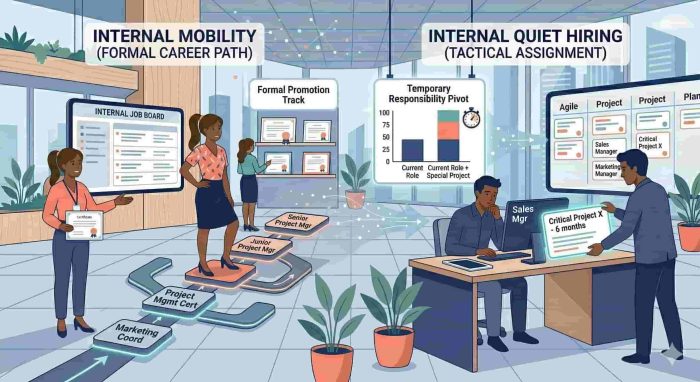
- Offer Incentives: This doesn’t always have to be a massive salary bump. It could be a one-time bonus, extra PTO, or a promised promotion track after a six-month “test” period.
- Set a Sunset Clause: If you’re bringing in a contractor or shifting an internal role “temporarily,” define what “temporary” means. Re-evaluate at the 90-day mark to see if the arrangement is sustainable.
- Automate the Logistics: Don’t rely on manual spreadsheets to track these fluid roles. Use tools that integrate directly into your workflow to track time, attendance, and project allocation.
Pro Tip: If you’re using AttendanceBot, you can easily set up custom “Job Codes” or “Project Tracking” within Slack. This allows you to see exactly how many hours your team is spending on these new “quiet” initiatives versus their core responsibilities, ensuring no one is being stretched to the breaking point.
Beyond the Budget: Building “Skill Liquidity”
There is a hidden strategic advantage to quiet hiring that most HR guides miss: Skill Liquidity.
In the traditional hiring model, skills are “locked” into specific job titles. If your Marketing Manager is also a talented data visualizer, that skill often goes to waste because it isn’t in their JD. Quiet hiring breaks those silos. By moving people to where the need is greatest, you create a more agile, cross-functional workforce that can pivot in days, not months.
In 2026, the most resilient companies aren’t the ones with the most employees; they are the ones who know exactly what their existing employees are capable of. When you treat your workforce as a portfolio of skills rather than a list of static roles, “hiring” becomes a constant, internal evolution rather than a reactive external expense. This shift toward skills-based talent management is why it’s identified as a structural necessity for modern CHROs.
Quiet Hiring FAQs
Is Quiet Hiring Legal?
Yes, quiet hiring is legal, provided that employment contracts allow for changes in job responsibilities. However, HR must ensure that reassignments don’t lead to “constructive dismissal” (making a job so difficult or different that an employee is forced to quit) and that compensation remains fair and non-discriminatory.
How does Quiet Hiring Affect Company Culture?
If handled transparently, it can improve culture by offering growth opportunities. If handled poorly (i.e., “quiet promotion” without a pay raise), it can lead to burnout and “quiet quitting.”
What is the Difference Between Quiet Hiring and Internal Mobility?
They are two sides of the same coin. “Internal mobility” is the long-term HR strategy of moving talent within a company. “Quiet hiring” is the tactical application of that strategy to fill a specific, urgent gap without an external search.
How AttendanceBot Makes Quiet Hiring Sustainable
At AttendanceBot, we built our platform to handle the fluidity of the 2026 workplace. We help HR teams manage the “quiet” shift by providing:
- Project Tracking: See exactly how many hours are being diverted to new internal initiatives.
- Burnout Prevention: Identify who is being stretched too thin before it leads to quiet quitting or loud layoffs.
- Contractor Management: Seamlessly track the hours of short-term freelancers used for external quiet hiring.
- Platform Integration: All of this happens inside Slack or Microsoft Teams, no new software for your already-busy employees to learn.
Don’t let your talent strategy stay in the dark. Use the tools that give you total visibility over your most valuable asset.
Conclusion: Turning “Quiet” into “Clarity”
Quiet hiring is no longer a “hack” used by tech giants; it is a foundational pillar of modern workforce management. In an era where AI changes the required skill set of a department overnight, the ability to reassign and upskill quickly is your greatest competitive advantage.
But “quiet” shouldn’t mean “invisible.” To make this strategy work, you need the right data. You need to know who is working on what, how much capacity they have left, and when a “stretch assignment” has officially become a new full-time role.