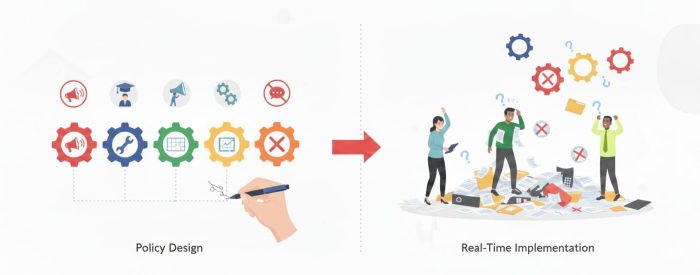
HR policy implementation rarely fails because the policy itself is flawed. Most policies are carefully reviewed, legally sound, and clearly documented. On paper, they make sense. Where things break down is much closer to the work, the point where theory meets reality.
The real failure happens at the “last mile”-the moment a leave request is approved in a Slack message, a schedule change is assumed instead of recorded, or a manager makes a quick judgment call to keep things moving. This is where policy execution in HR stops being about rules and starts becoming about interpretations.
For HR teams, this creates a quiet but persistent problem. The policy exists, but execution is inconsistent. Decisions vary by manager, and exceptions pile up. Until HR policies and implementation are designed for how work actually happens, in chats, handoffs, and fast-moving teams, even the best-written policies will continue to fail.
The last mile of HR policy implementation is the point where written rules meet daily work—typically in Slack, email, or verbal approvals. Failure occurs here when HR policy enforcement becomes an interpretation rather than a structured process. Organizations can solve this by transitioning to HR process automation, which embeds policy logic directly into HR operational workflows, ensuring that every decision is consistent, auditable, and scalable.
What the “Last Mile” Means in HR
In HR, the “last mile” is the point where policy meets day-to-day work. It’s not in a handbook or wiki; it’s in the interactions that actually make or break HR policy implementation. It happens when:
- An employee requests time off in Slack or via email.
- A manager approves or denies a request based on intuition rather than the policy.
- A schedule change and no one updates the system.
- Availability is assumed instead of confirmed.
These are ordinary moments, but they’re where human resources workflow processes stop being rules and start being interpreted. Most HR teams focus on writing and publishing policies, but few design the HR workflow that ensures consistent execution. Without a clear system, HR policy enforcement becomes ad hoc, reliant on memory and informal approvals.
The 5 Reasons HR Policies Fail at the Last Mile
The 5 Reasons HR Policies Fail at the Last Mile
Even well-written policies stumble in real-world work because HR policy implementation breaks down where work actually happens.
1. Policies Depend on Human Memory
HR policies are often designed with an implicit expectation that humans will remember the rules. In practice, managers rely on intuition, and employees interpret guidelines through personal experience. This reliance undermines policy consistency in HR and makes results unpredictable.
2. Execution Happens in Unstructured Spaces
Most work today unfolds in communication tools like Slack or email places built for speed, not for rules. Problems arise when context gets lost in long threads or decisions vary widely from one manager to another. Without people operations systems to guide choices, critical decisions happen outside the policy’s visibility.
3. Policies Compete With Speed
In high-velocity environments, momentum often wins over compliance. This trade-off is one of the biggest challenges in HR operations, typically resulting from unautomated, manual HR operational workflows.
4. Enforcement Feels Like Micromanagement
HR teams often worry about appearing controlling or causing a culture backlash. Consequently, policies become guidelines instead of guardrails. Without automated HR workflows that embed rules at the point of decision, enforcement feels personal, causing many managers to avoid it.
5. No One Owns the System
It’s common to think HR writes the policy and managers enforce it. But if no one owns the HR workflow automation, the part that actually makes decisions consistent, the system fails. Without a clear owner for managing HR policies at scale, implementation remains fragmented.
The Anatomy of a Broken Workflow: A Case Study in Friction
To understand why HR policy implementation fails, we have to look at the anatomy of a typical “unstructured” request. Imagine an employee, Sarah, who needs to request a shift swap due to a family emergency.
In a company without HR workflow automation, the process looks like this:
- The Informal Ask: Sarah sends a Slack message to her manager at 9:00 PM.
- The Intuitive Approval: Her manager, busy with dinner, replies, “Sure, no problem,” forgetting that the company policy requires a 48-hour notice for swaps to ensure safety compliance.
- The Data Gap: The swap happens, but the human resources workflow processes are never updated. The payroll system still thinks the original person worked the shift.
- The Friction Point: Two weeks later, payroll is incorrect. HR has to spend three hours auditing Slack logs and emails to find out who was actually on-site.
This is a classic example of how HR operations challenges snowball. It isn’t just a “missed update,” it is a failure of policy execution in HR. Because the HR workflow process was not embedded in the communication tool, the policy became a suggestion rather than a rule. When you multiply this by 50 or 100 employees, you don’t just have a data problem; you have an operational crisis. This is why managing HR policies at scale is impossible without a digital backbone.
The Hidden Costs: Why This Is an Operational Crisis
These failure points don’t just create confusion; they create a “tax” on your company culture. When HR policy implementation fails at the last mile, the impact is a slow erosion of trust, efficiency, and consistency.
- Manager Decision Fatigue: When policy execution in HR requires individual interpretation every time, managers burn cognitive energy on routine approvals. Harvard Business Review notes that this fatigue leads to suboptimal choices in high-pressure environments.
- Perceived Unfairness: Inconsistent HR policy enforcement creates the impression that some employees get exceptions while others do not. This damages the credibility of your people operations systems.
- HR Firefighting: Teams spend more time clarifying rules and resolving disputes than building the human resources workflow processes needed for growth.
Why More Training and Documentation Don’t Fix This
The knee-jerk response to these costs is often to “run another manager training” or “clarify the handbook”. While this feels productive, it doesn’t address the root cause: HR operations challenges are rarely caused by a lack of knowledge; they are caused by a lack of structure.
Policies fail because execution is left to chance, human memory, and unstructured chat apps. Even the best training cannot enforce 100% consistency. As Harvard Business Review highlights, even highly trained employees make inconsistent choices under pressure. To succeed, organizations must move toward HR process automation where the rules are built into the tools, not just the document.
The Solution: Moving from Document to Workflow
If the problem is that policies are static while work is fluid, the solution is to make the policy part of the work. This marks the shift toward automating HR operations. By moving rules into the tools where work happens, companies can automate employee requests to ensure every action aligns with company standards.
The Strategic Benefits of Policy-as-Workflow
- Decisions are captured automatically: Approvals and leave requests are recorded in real-time through HR workflow automation.
- Self-service reduces exceptions: Employees complete routine tasks without needing a manager’s subjective interpretation.
- Visibility improves: HR gains a clear view of human resources workflow processes, enabling proactive adjustments instead of firefighting.
| Traditional Policy (The “Paper” Way) | Policy-as-Workflow (The “Automation” Way) |
| Relies on the manager’s recall of the handbook. | Rules are pre-programmed into the HR workflow. |
| Requests are lost in Slack threads. | Requests are tracked in a centralized HR automated workflow. |
| High risk of “favoritism” or inconsistent approvals. | Guardrails ensure policy consistency in HR for everyone. |
| HR spends 40% of time answering “What is the policy?” | HR spends time on strategy because the system handles the “What.” |
Implementing Automation in HR Processes
To bridge the gap between policy and action, organizations are increasingly turning to automation in HR processes like onboarding, leave management, and availability tracking.
HR operations automation creates a “digital guardrail”. Whether it is automation in HR operations or specific automated HR workflows, technology ensures that the system handles the heavy lifting of compliance. Implementing a robust HR workflow automation strategy allows HR teams to move from being “policy police” to being strategic partners.
Building a Scalable Infrastructure with AttendanceBot
Solutions like AttendanceBot fit naturally into this context. They provide the essential infrastructure to make HR policy implementation seamless in real-world work. By integrating directly into Slack or Microsoft Teams, they transform a static handbook into a living HR automated workflow that is:
- Scalable: Consistent across diverse teams and global locations.
- Resilient: Less reliant on the memory of individual managers.
- Auditable: Transparent and ready for compliance reporting at a moment’s notice.
- Predictable: Employees know exactly what to expect, which fosters workplace trust.


The Roadmap: How to Move from Static Policies to Living Workflows
Transitioning to HR operations automation doesn’t happen overnight. It requires a strategic shift in how you view your people operations systems. If you are ready to fix your last-mile failure, follow this three-step roadmap:
Step 1: Audit Your Informal Channels: Look at where your HR workflow is actually happening today. Is it in Slack? WhatsApp? Hallway conversations? Identify the high-traffic areas where human resources workflow processes are currently being bypassed.
Step 2: Map the Logic, Not the Document: Don’t just upload a PDF to a drive. Take your most frequent automated HR workflows-like PTO requests or expense approvals-and write out the “if/then” logic.
- Example: IF the employee has 5 days of PTO available AND no more than 2 people are off that day, THEN auto-approve.
Step 3: Embed the Tool in the Workflow: This is where automation in HR processes becomes powerful. Choose a tool like AttendanceBot that lives where the work happens. If your team spends 8 hours a day in Microsoft Teams, that is where your HR workflow automation should live.
By making the policy the “path of least resistance,” you ensure that HR policy implementation is no longer a manual struggle. You turn your HR team from “policy police” into architects of a high-performance culture.
Frequently Asked Questions (FAQ)
1. What is the biggest challenge in HR policy implementation?
The most significant of all HR operations challenges is the “last mile”—the gap between a written policy and its day-to-day execution. When HR policy enforcement relies on human memory or unstructured chat messages, consistency breaks down. Solving this requires moving from static documents to automated HR workflows that embed rules directly into the tools your team already uses.
2. How does HR process automation improve policy consistency?
HR process automation removes the subjective “interpretation” of rules from individual managers. By using an HR automated workflow, every request is checked against the same logic. This ensures that policy consistency in HR is maintained across different departments and locations, reducing perceived unfairness and building employee trust.
3. Can you automate employee requests without losing the “human touch”?
Yes. Automation in HR operations isn’t about replacing human judgment; it’s about removing the administrative friction of routine tasks. When you automate employee requests for things like PTO or shift swaps, you free up HR professionals to focus on complex “human” issues like conflict resolution and talent development, rather than chasing down email threads.
4. Why isn’t manager training enough to fix policy execution in HR?
While training is important, it cannot solve the problem of decision fatigue. In high-pressure environments, even well-trained managers may bypass a human resources workflow process to save time. HR workflow automation acts as a digital guardrail that makes following the policy the path of least resistance, ensuring HR policy implementation (PKW) succeeds even when teams are busy.
5. How do I start managing HR policies at scale?
To begin managing HR policies at scale, you must transition from manual tracking to automation in HR processes. Start by auditing your most frequent HR operational workflows and implementing tools like AttendanceBot. This creates a scalable infrastructure that allows your people operations systems to grow alongside your headcount without increasing the administrative burden on your team.
Key Takeaway: Execution, Not Paper, Determines Success
Ultimately, HR policy implementation doesn’t fail because policies are poorly written; they fail because execution is left to chance, buried in threads and interpreted differently by every manager.
The “last mile” is where policy execution in HR either succeeds or erodes. By treating policies as living workflows rather than static documents, you stop relying on human memory and start relying on automation in HR processes. When you automate employee requests and manage the last mile through a structured HR automated workflow, your policies start delivering the stability and fairness they were designed to provide.
Looking for more ways to automate your workspace? Explore the full Harmonize Hub ecosystem – the central home for AttendanceBot, OfficeAmp, and our latest tools like Filo and Code2Docs, all designed to make your work life seamless.