Remote work promised freedom: no commute, flexible schedules, and the ability to focus without office distractions. Yet for many, a different feeling has quietly crept in: uncertainty.
Without hallway conversations or quick desk check-ins, workers often wonder if they are aligned with the rest of the team. Are they working on the right priority? Did anyone see the update they posted yesterday? Is someone else already handling the task they just started?
That constant second-guessing is one of the hidden drivers of remote work stress. When communication becomes fragmented, even high-performing teams can feel disconnected. This is where a daily standup Slack routine helps remove that uncertainty.
“A daily standup slack routine reduces remote team anxiety by replacing the ‘visibility vacuum’ with structured, asynchronous transparency. By utilizing a slack daily standup bot, teams can document progress and surface blockers without the pressure of constant ‘always-on’ connectivity. This async standup slack approach fosters psychological safety, as it normalizes help-seeking through standard daily standup questions and ensures alignment without interrupting deep work.”

The Power of the Slack Daily Standup
Instead of waiting for long meetings or scattered updates across endless threads, teams can share quick async team updates about what they’re working on, what they completed yesterday, and where they might need help. The result is a lightweight system of visibility that keeps everyone aligned without interrupting deep work.
What makes the Slack daily standup so effective is not only the operational benefit, but the real impact is psychological.
Moving Toward an Async Standup Slack Workflow
A structured daily standup in Slack creates a sense of progress, accountability, and connection for remote workers. It signals that work is moving forward, that teammates are present, and that no one is navigating the day alone.
That is why more distributed teams are adopting an async standup Slack workflow powered by automation. With the help of a Slack daily standup bot or a daily standup bot Slack, the routine becomes effortless. These tools turn a simple check-in into a powerful habit that improves remote team communication and reduces the quiet anxiety that often comes with digital isolation.
Why Remote Work Quietly Increases Anxiety for Many Employees
While the flexibility of home office life is a perk, the lack of physical presence often creates a “visibility vacuum.” In a traditional office, you can see your manager nodding at a screen or hear a colleague mention a finished task. In a digital environment, that feedback loop disappears, leading to several specific stressors:
- The “Always On” Pressure: Without a clear stand up meeting to signal the start of the day, employees often feel they must be constantly active on chat apps to prove they are working.
- Information Silos: When updates aren’t centralized, team members worry they missed a crucial decision made in a private DM or a niche thread.
- The Hesitation to Ask: In person, it’s easy to poke a head over a cubicle. Remotely, asking for a “quick sync” can feel like an intrusion, leading to “blocker anxiety” where a small issue halts progress for hours.
Bridging the Gap with an Agile Daily Standup
To address this, many teams are adopting the Scrum Daily Standup model. Traditionally used in software development, an agile daily standup is designed to surface blockers immediately. When you bring this standup in Slack, you provide a dedicated space for these concerns to live.
By shifting to an asynchronous daily standup, employees no longer have to worry about “performing” to be productive. They can simply post their update and get back to their deep work, knowing their progress is visible and valued. This transparency is the ultimate antidote to the isolation of remote roles.
Effective Daily Standup Questions to Reduce Stress
The key to reducing anxiety isn’t just doing a standup; it’s asking the right things. Using standard daily standup questions helps keep the focus on clarity rather than micromanagement:
- What did you accomplish yesterday? (Celebrates progress)
- What are you focusing on today? (Provides alignment)
- Are there any blockers in your way? (Invites support)
By normalizing the mention of “blockers” in a team standup Slack channel, you remove the stigma of asking for help, which is often the biggest source of remote work tension.
Daily Standup Best Practices for Slack
Transitioning your ritual to a digital space requires more than just a new channel; it requires a shift in how you communicate. To keep your team standup Slack updates effective and stress-free, follow these daily standup best practices:
- Prioritize Blockers Over Lists: A common mistake is listing every minor email sent. Instead, focus on progress. If you are stuck, flag it early. The primary goal of an agile daily standup is to ensure the team can move forward, not to micromanage your time.
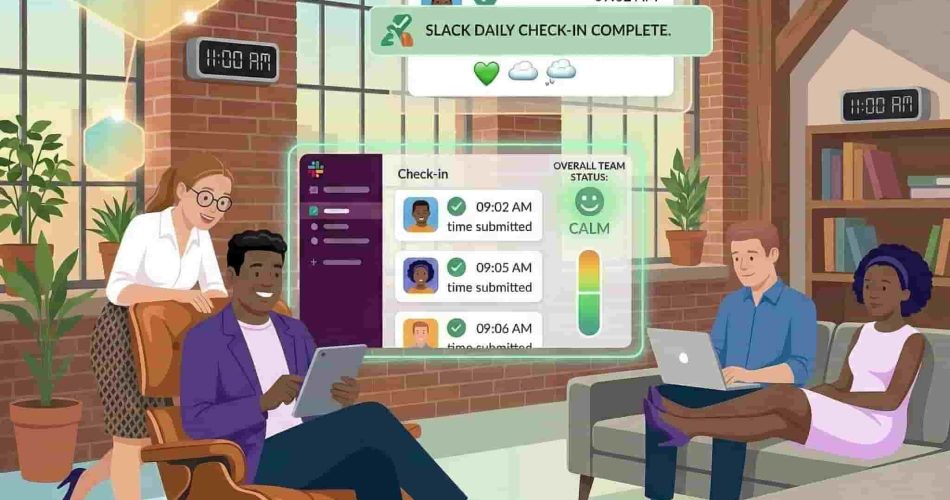
- Respect the “Golden Window”: While the beauty of an asynchronous standup is flexibility, try to have all updates posted by 10:00 AM local time. This ensures that the information is relevant for the majority of the workday.
- Keep Discussions in Threads: To avoid cluttering the main standup in Slack channel, move detailed technical discussions into threads. This keeps the main feed scannable for everyone else.
- Humanize Your Updates: Remote work can feel robotic. Use emojis to indicate your mood or the status of a project. A simple 🔴 for a blocker or a ✅ for a win makes a Slack daily standup much more engaging and reduces the “clinical” feel of digital communication.
The Best Daily Standup Software and Tools (2026)
Choosing the right daily standup software can make the difference between a helpful habit and a chore. In 2026, these daily standup tools offer deep automation and AI insights to keep your team aligned.
| Tool | Best For | Key Feature | Link |
| Kollabe | AI-First Teams | AI Summaries: Generates automated daily “TL;DR” reports so you can catch up on the whole team in seconds. | Visit Kollabe |
| AttendanceBot | Workflow Automation | Integrated Check-ins: Combines async updates with attendance tracking and PTO management in one workflow. | Visit AttendanceBot |
| Geekbot | Minimalist Teams | Conversational UI: A highly intuitive daily standup bot Slack users love for its simple, DM-based interface. | Visit Geekbot |
| Range | Culture & OKRs | Work-Life Balance: Connects standups to mood tracking and long-term goals to prevent burnout. | Visit Range |
| Standuply | Agile Power Users | Digital Scrum Master: Automates complex scrum daily standup ceremonies, including planning poker and retrospectives. | Visit Standuply |
| DailyBot | Morale & Rewards | Kudos & Pulse: Ideal for teams focusing on social connection alongside their asynchronous daily standup. | Visit DailyBot |
For many, the most seamless entry point is a daily standup bot Slack integration. These bots act as a neutral “facilitator,” prompting team members at the right time in their local timezone. This is why the asynchronous daily standup has become the gold standard for global teams-it respects the “deep work” of developers and creatives while ensuring no one is left in the dark.

The Science of Connection: Research on Remote Work Anxiety
The claim that a daily standup in Slack reduces anxiety isn’t just anecdotal. Recent studies in organizational psychology highlight how structured communication acts as a buffer against the unique stressors of distributed work.
1. Combating “Telepressure” and Burnout
According to a 2025 study on Remote Work and Occupational Stress published in MDPI, the lack of clear boundaries in remote work often leads to “telepressure”-the overwhelming urge to respond to digital messages immediately to prove one’s presence.
By using an asynchronous daily standup, teams provide a “public record” of productivity. This reduces the internal pressure to be “performatively active” on chat apps. When a daily standup bot Slack collects updates, it creates a predictable rhythm that lowers the anxiety associated with “invisible work” and helps prevent job burnout.
2. Eliminating the “Isolation Gap”
The 2023 State of Remote Work report by Buffer revealed that loneliness (23%) and the inability to unplug (22%) remain the top struggles for remote employees. Furthermore, a 2024 Gallup report found that remote workers experience daily loneliness at a rate 56% higher than fully onsite employees.
By answering standard daily standup questions every morning, employees receive a “micro-dose” of social connection. A 2025 study on fostering belonging in Agile teams notes that “continuous, conscious, and visible actions” are required to maintain team cohesion. A standup in Slack signals that the team is present and moving toward a collective goal, which directly counters the physiological effects of isolation.
3. Building “Swift Trust” Through Transparency
Research on trust in virtual teams suggests that remote groups rely on “Swift Trust.” This is a form of trust built not on long lunches, but on reliable, documented action.
Shifting to an async standup Slack model allows employees to process information at their own pace. This creates “cognition-based trust,” where team members feel secure because they can see in real-time that their colleagues are competent and reliable. This visibility is the ultimate shield against the “second-guessing” anxiety mentioned earlier.
Conclusion: Turning Check-Ins into a Competitive Advantage
At its core, reducing remote team anxiety is about replacing silence with clarity. Whether you use a daily standup bot Slack integration to save time or prefer a manual team standup Slack channel, the goal remains the same: ensuring no one feels like they are working in a vacuum.
By adopting these daily standup best practices and leveraging the right daily standup tools, you transform a simple status update into a pillar of team well-being. The result isn’t just a more productive team-it’s a healthier, more resilient one.
Frequently Asked Questions (FAQ)
1. How does a daily standup Slack routine differ from a traditional meeting?
A traditional stand-up meeting usually happens in real-time, requiring everyone to stop working at once. In contrast, a daily standup in Slack is often “asynchronous.” This means team members can post their updates when it fits their flow, which is a core part of daily standup best practices for avoiding meeting fatigue.
2. What are the best daily standup questions to ask?
To keep the team focused and reduce anxiety, most daily standup tools suggest these three standard prompts:
- What did you do yesterday?
- What will you do today?
- Are there any blockers or impediments in your way?
3. Is an asynchronous standup as effective as a live one?
Yes, and for many remote teams, an asynchronous daily standup is actually more effective. It creates a written record of progress, respects deep work blocks, and allows team members in different time zones to participate without waking up at 3:00 AM for a call.
4. Do we really need a daily standup bot Slack integration?
While you can run a team standup Slack routine manually by having everyone post in a channel, a Slack daily standup bot automates the reminders and collates the data. This “set it and forget it” approach ensures the habit sticks and prevents the manager from having to “nag” the team for updates.
5. How can a Slack daily standup reduce team stress?
By making work visible, a Slack daily standup eliminates the “visibility vacuum.” Employees feel less pressure to be “always online” because their progress is documented. It also normalizes asking for help, which significantly lowers the anxiety of being stuck on a task alone.
6. Can we use these tools for a scrum daily standup?
Absolutely. Most daily standup software is built specifically with agile daily standup and scrum daily standup frameworks in mind. These tools help maintain the discipline of the Scrum framework while adapting it to a modern, flexible remote environment.
Looking for more ways to automate your workspace? Explore the full Harmonize Hub ecosystem – the central home for AttendanceBot, OfficeAmp, and our latest tools like Filo and Code2Docs, all designed to make your work life seamless.