Performance review season has a reputation problem.
Managers dread writing them. Employees dread receiving them. HR teams dread chasing completions for three weeks while trying to normalize ratings that somehow range from “meets expectations” to “exceptional” for people doing nearly identical work. And at the end of it all, the feedback is often too vague, too late, and too disconnected from what actually happened across the year to drive meaningful change.
According to the 2026 CHRO Survey Report, 91% of CHROs cite AI and workplace digitization as their top priority this year, and performance management is one of the first places they’re putting it to work. Not to replace human judgment, but to eliminate the manual overhead that makes the review process so painful in the first place.
This guide is the practical version of that conversation. Not a pitch for any particular platform, but a real walkthrough of how AI performance reviews work, what they’re actually good at, where they fall short, and the specific prompts that help managers and employees get more out of every review cycle. We’ve also included how to use your existing time tracking and attendance data from AttendanceBot to make AI-generated feedback more grounded, specific, and fai
AI performance reviews use artificial intelligence to help HR teams and managers generate draft feedback, detect bias, analyze performance trends, and streamline the entire review cycle. In 2026, the right approach combines AI-generated starting points with human judgment, real attendance and time tracking data, and structured prompts that produce specific, actionable feedback. AI doesn’t replace the performance conversation; it makes it better.
TL;DR, Quick Summary
- AI reduces performance review admin time without replacing human judgment
- The best AI reviews are grounded in real data, including time tracking and attendance
- Managers and employees both benefit from structured AI prompts
- Bias, privacy, and over-reliance are the three biggest risks to manage
- AttendanceBot time tracking data gives AI performance tools the objective context they need
Why Traditional Performance Reviews Keep Failing
The Annual Review Was Never Designed for How We Work Now
The once-a-year performance review made sense when managers worked alongside their teams every day and had constant, direct visibility into performance. In 2026, with hybrid teams, async workflows, and employees spread across time zones, that visibility has fundamentally changed. Asking a manager to produce a fair, comprehensive performance evaluation based on 12 months of imperfect recall isn’t just inefficient, it’s structurally broken.
Recency bias takes over. The employee who delivered something visible in November gets a better review than the one who quietly carried the team through Q2. High-visibility personalities outperform quiet contributors on paper, regardless of actual output.
Manual Reviews Consume Time HR Teams Don’t Have
Real-time AI dashboards have been shown to reduce review cycle time from months to weeks, which tells you something about how long manual cycles were taking in the first place. For small business HR teams running lean, a review cycle that takes months of prep, chasing, and calibration is a genuine operational burden that competes directly with everything else on the HR agenda.
Feedback Quality Suffers Without Data
Most managers walk into performance conversations with their own memory and whatever notes they’ve managed to keep. That produces feedback that’s generic, inconsistent, and hard for employees to act on. AI sentiment analysis from performance reviews can help identify patterns linked to turnover risk months in advance, but that kind of insight is only possible when the review data is specific enough to analyze. Vague ratings and boilerplate feedback produce nothing useful downstream.
The Bias Problem Is Real and Largely Invisible
Many reports indicate that managers may use AI tools to write performance reviews without taking into account an employee’s actual performance or duties, which is why HR leaders need clear policies on both the right and wrong ways to use AI in reviews. But the bias problem predates AI. Manual reviews have always reflected the unconscious preferences, cultural assumptions, and interpersonal dynamics of whoever is writing them. AI used correctly reduces that bias. AI used carelessly amplifies it.
What AI Actually Does Well in Performance Reviews
Generating Draft Feedback From Real Data
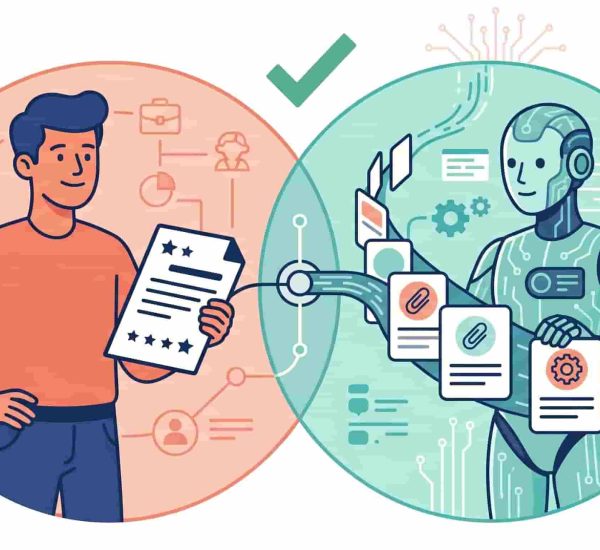
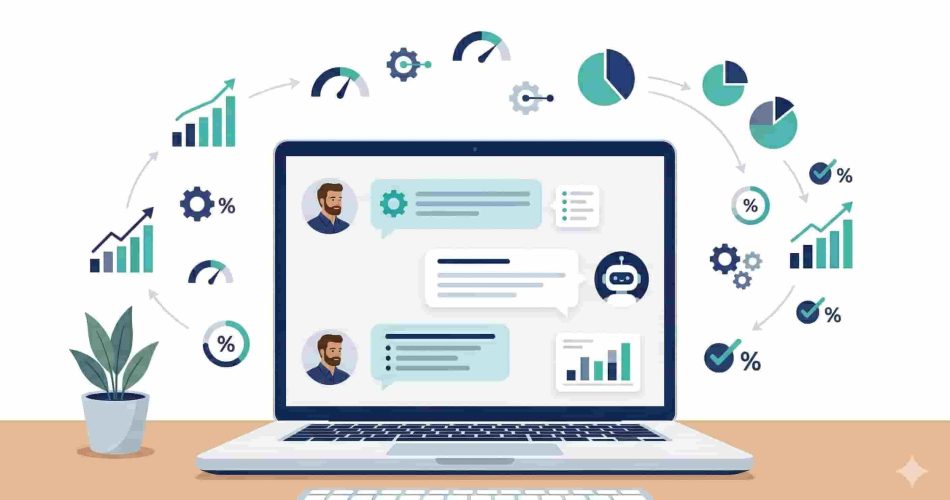
The most immediately useful thing AI does in the performance review process is give managers a structured starting point instead of a blank page. Feed it goal completion data, peer feedback, check-in notes, and attendance patterns, and it generates a draft that covers the key themes, uses specific language, and gives the manager something to refine rather than create from scratch.
This is not about letting AI write the review. It’s about eliminating the cognitive paralysis of starting from nothing, which is where most review delays actually come from.
Detecting Bias in Review Language
AI can scan draft feedback for patterns that suggest unconscious bias, gendered language, inconsistent tone across employee groups, disproportionate focus on personality rather than outcomes, or language that describes the same behavior differently depending on who performed it.
Synthesizing 360-Degree Feedback
360 degree feedback from managers, peers, direct reports, and sometimes customers produces a rich dataset, but synthesizing it manually into a coherent narrative is time-consuming and cognitively demanding. AI can aggregate the themes, identify patterns across responses, flag contradictions, and produce a summary that gives the reviewer a complete picture without requiring them to read and reconcile dozens of individual submissions.
Supporting Employee Self-Evaluations
Self-evaluation performance reviews are most useful when employees reflect genuinely rather than defensively. AI prompts help employees articulate their contributions clearly, connect their work to business outcomes, and frame challenges as growth opportunities, producing self-assessments that are more specific, more useful, and less likely to put managers on the defensive before the conversation even starts.
AI Prompts for Managers: Get Better Reviews Faster
These prompts are designed to work with any general-purpose AI tool, ChatGPT, Claude, Gemini, or the AI writing assistant inside your performance review software. The quality of the output depends entirely on the quality of the input, so each prompt includes guidance on what data to include.
Important: Never include employee names or personally identifiable information in prompts sent to external AI tools. Use job titles and role descriptions instead.
Prompt 1: Generate a Draft Performance Review
“Write a performance review summary for a [job title] at a [company size] [industry] company. During this review cycle, they [list 3–5 key achievements]. Challenges that came up include [list 1–2 honest challenges]. Their attendance record shows [X sick days, Y late arrivals, or consistent punctuality]. Their overall contribution to the team has been [brief description]. Use a balanced, constructive tone and focus on specific behaviors rather than personality traits.”
What to include: Goal completion data, specific project outcomes, attendance patterns from AttendanceBot, and any 1:1 notes or check-in summaries.
Prompt 2: Improve Vague Feedback
“I’ve written the following performance review comment: [paste comment]. It feels too vague and generic. Rewrite it to be more specific, behavior-focused, and actionable. Maintain a [supportive/direct/developmental] tone. Here are some specific examples I can add: [list examples].”
When to use: When you’ve written something you know is weak but can’t immediately identify why or how to fix it.
Prompt 3: Check for Bias
“Review the following performance feedback for signs of unconscious bias, including gendered language, inconsistent standards compared to feedback I’ve written for other employees, or disproportionate focus on personality versus outcomes. Highlight anything that concerns you and suggest neutral alternatives: [paste feedback].”
What to include: Multiple review drafts for different employees, so the AI can compare language patterns across them.
Prompt 4: Synthesize 360 Feedback
“I’ve collected peer and manager feedback for a [job title]. Here are the key themes from their peers: [summarize]. Here are the themes from their direct reports: [summarize]. Here is my own manager assessment: [summarize]. Synthesize these into a coherent narrative that highlights consistent strengths, flags areas of disagreement between sources, and identifies the top two development priorities.”
What to include: Anonymized summaries of peer feedback themes, not verbatim quotes that could identify individual reviewers.
Prompt 5: Turn Attendance Data Into Performance Context
“A [job title] on my team has the following attendance and time tracking patterns over the past six months: [e.g., consistently clocks in 15 minutes early, took 8 sick days clustered in Q3, regularly works late on Thursdays before Friday deadlines]. Help me interpret these patterns in the context of a performance review. What might they suggest about workload, engagement, or well-being that I should address in our review conversation?”
What to include: Time tracking and attendance data exported from AttendanceBot. This is where the connection between your time tracking data and AI performance management becomes genuinely powerful; patterns that would otherwise go unnoticed become meaningful context for the review conversation.
Prompt 6: Write a Performance Improvement Plan (PIP) Opening
“A [job title] has consistently [describe performance gap, e.g., missed three consecutive project deadlines, received repeated feedback about communication]. I need to open a performance improvement conversation constructively. Write an opening statement for our meeting that acknowledges their contributions, names the specific performance concern without being accusatory, and frames the conversation as collaborative problem-solving.”
AI Prompts for Employees: Own Your Self-Evaluation
Self-evaluations are where most employees either sell themselves short or write something so vague it reads like a job description. These prompts help employees write self-assessments that are specific, confident, and useful.
Prompt 1: Turn a List of Achievements Into a Narrative
“Here is a list of things I accomplished this review cycle: [paste list]. Turn this into a concise self-evaluation narrative that connects my contributions to business outcomes, highlights key themes in my work style, and uses confident, professional language. My job title is [title], and my main responsibilities are [describe].”
Prompt 2: Frame a Challenge as Growth
“This review cycle, I struggled with [describe challenge honestly]. I want to include this in my self-assessment in a way that shows self-awareness and growth without being overly self-critical or making excuses. Help me write two to three sentences that acknowledge the challenge and describe what I learned or changed as a result.”
Prompt 3: Prepare for the Review Conversation
“My job title is [title], and I’ve been at the company for [X years]. My main achievements this cycle include [list]. I expect my manager might raise [describe likely feedback area]. Write five questions I can ask in my performance review to make the conversation more productive, including questions about my development path, how my work connects to company goals, and what success looks like in the next cycle.”
Prompt 4: Write a Promotion Case
“I want to make a case for promotion from [current title] to [target title]. My key accomplishments this year include [list]. My tenure at the company is [X years], and my current salary is [X]. Help me write a concise, evidence-based promotion request I can include in my self-evaluation or raise directly with my manager.”
How AttendanceBot Data Makes AI Performance Reviews More Accurate
One of the most underused inputs in any AI performance review process is objective time and attendance data. Most managers rely entirely on qualitative memory and subjective impressions, but the data that actually tells the story of how someone works is already sitting in your time tracking system.
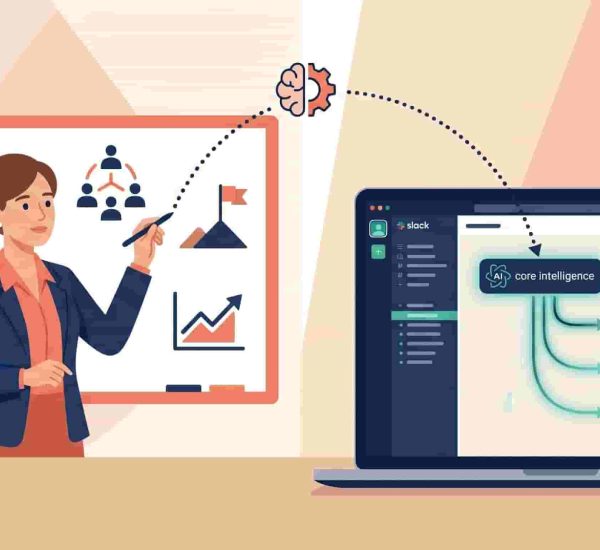
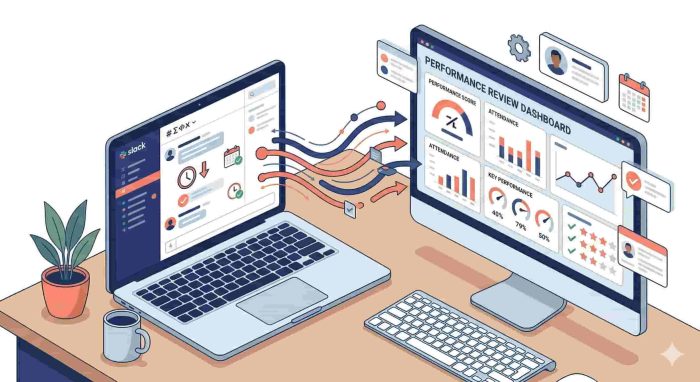
For teams using AttendanceBot inside Slack or Microsoft Teams, this data is captured automatically throughout the year. Here’s how to put it to work in your review cycle:
Attendance Patterns as Performance Context
Consistent punctuality, patterns of absence, and changes in check-in behavior over time are all signals worth examining in a performance review. A cluster of sick days in a particular quarter might indicate burnout or a personal circumstance worth acknowledging. Consistently early clock-ins might signal engagement that deserves recognition. Neither would show up in a standard qualitative review without the data to surface it.
Overtime Data as Workload Evidence
If an employee regularly works beyond their scheduled hours, that’s objective evidence of commitment, or of a workload problem that the performance conversation should address. AttendanceBot’s overtime tracking gives managers concrete data to reference, reducing the risk that a hardworking employee goes unrecognized because their effort wasn’t visible in the right meetings.
Check-In Consistency for Remote and Hybrid Teams
For remote and hybrid teams, daily check-ins and standup participation are often the primary visibility signal managers have. AttendanceBot’s daily check-in and standup features create a documented record of engagement and communication patterns that can meaningfully inform a continuous performance management process, giving managers objective data points to reference alongside qualitative feedback.
Risks to Watch When Using AI for Performance Reviews
AI Is Only as Good as the Data You Feed It
Garbage in, garbage out. An AI tool that generates a performance review from vague bullet points will produce vague feedback. The prompts above work because they require you to gather specific, concrete information before asking AI to synthesize it. If you skip the data gathering, the AI output won’t be meaningfully better than what you’d write yourself.
Privacy Matters More Than People Realize
Data privacy experts consistently warn against feeding confidential employee information into open AI models not covered by your company’s data protection policies. Use job titles instead of names, anonymize specific details, and stick to AI tools your organization has formally approved. This is especially important for small businesses that may not have formal AI usage policies yet.
Transparency Builds Trust
HR Dive reports that if managers use AI to write reviews without disclosing it, trust between managers and their teams can be negatively affected when employees find out. The solution isn’t to avoid AI, it’s to be transparent about how it’s being used. Framing AI as a drafting and bias-checking tool, with all final feedback reviewed and personalized by the manager, is both honest and defensible.
Don’t Let AI Replace the Conversation
The performance review conversation, the actual human exchange between a manager and an employee, is where growth happens. AI can make the paperwork better, but it cannot replace the judgment, empathy, and relationship context that make a performance conversation genuinely valuable. Use AI to prepare better. Show up as a human.
Best Practices for Responsible AI Use in Performance Reviews
- Establish a clear AI usage policy before review season so managers know what’s permitted and what isn’t
- Always review and personalize AI-generated draft feedback, never submit it unedited
- Use objective data from time tracking, goal completion, and check-ins as inputs, not just subjective impressions
- Run bias checks on all draft feedback before finalizing, using either AI tools or a second human reviewer
- Be transparent with employees about how AI is used in the review process
- Treat AI as a starting point, not a finishing line. The human judgment layer is non-negotiable
Frequently Asked Questions
What Are AI Performance Reviews?
AI performance reviews use artificial intelligence to support the employee evaluation process, generating draft feedback, detecting bias, synthesizing 360-degree input, and reducing the manual overhead of the review cycle. AI doesn’t replace human judgment in reviews; it gives managers and employees better starting points and more objective data to work with.
Are AI Performance Reviews Fair?
Used correctly, automated performance reviews are fairer than fully manual ones, because AI can detect bias patterns in language that humans often miss. AI bias mitigation has been shown to produce fairer ratings in many performance evaluations. The key is grounding AI output in real performance data rather than generating reviews from minimal input.
What Data Should I Feed Into AI for Performance Reviews?
The best AI performance management inputs include goal completion data, attendance and time tracking records, peer feedback themes, 1:1 notes, check-in summaries, and specific project outcomes. The more concrete and specific the input, the more useful the AI output. For teams using AttendanceBot, time tracking and attendance data are already captured automatically, making it a ready-made input for richer, more objective reviews.
Can AI Replace the Performance Review Conversation?
No, and it shouldn’t. AI performance reviews are a tool for reducing administrative overhead and improving the quality of written feedback. The actual performance conversation between a manager and employee is where growth, trust, and development happen, and that requires human judgment, empathy, and relationship context that no AI tool replicates.
How Do I Avoid Bias in AI-Generated Performance Reviews?
Use Prompt 3 from the manager section above to explicitly ask AI to check your draft feedback for bias. Avoid including demographic information in prompts. Compare language across multiple review drafts to identify inconsistencies in standards. Always have a human reviewer read final feedback before it reaches the employee.
Is It Ethical to Use AI for Employee Performance Reviews?
Yes, when used transparently and responsibly. The ethical line is using AI as a drafting and analysis tool while maintaining human accountability for every final review. HR leaders recommend being clear with teams about how AI is used in the review process and ensuring managers never submit AI-generated feedback without meaningful personalization.
Better Data Makes Better Reviews, Starting Today
The most common reason AI performance reviews fall flat isn’t the AI. It’s the absence of good data to feed into it. Managers who walk into review season with nothing but memory and meeting notes will get generic output from even the best AI tools.
The teams that get the most out of AI performance management are the ones that have been collecting objective data throughout the year, goal completion records, check-in histories, time tracking patterns, and attendance data that tells the real story of how someone shows up and contributes.
If your team uses AttendanceBot for time tracking, attendance, and daily check-ins inside Slack or Microsoft Teams, you’re already building that data foundation automatically. Every clock-in, every leave request, every standup response is a data point that can make your next performance review cycle more accurate, fairer, and significantly less painful.
Book a free AttendanceBot demo and see how automated time tracking creates the data foundation your performance reviews have been missing.